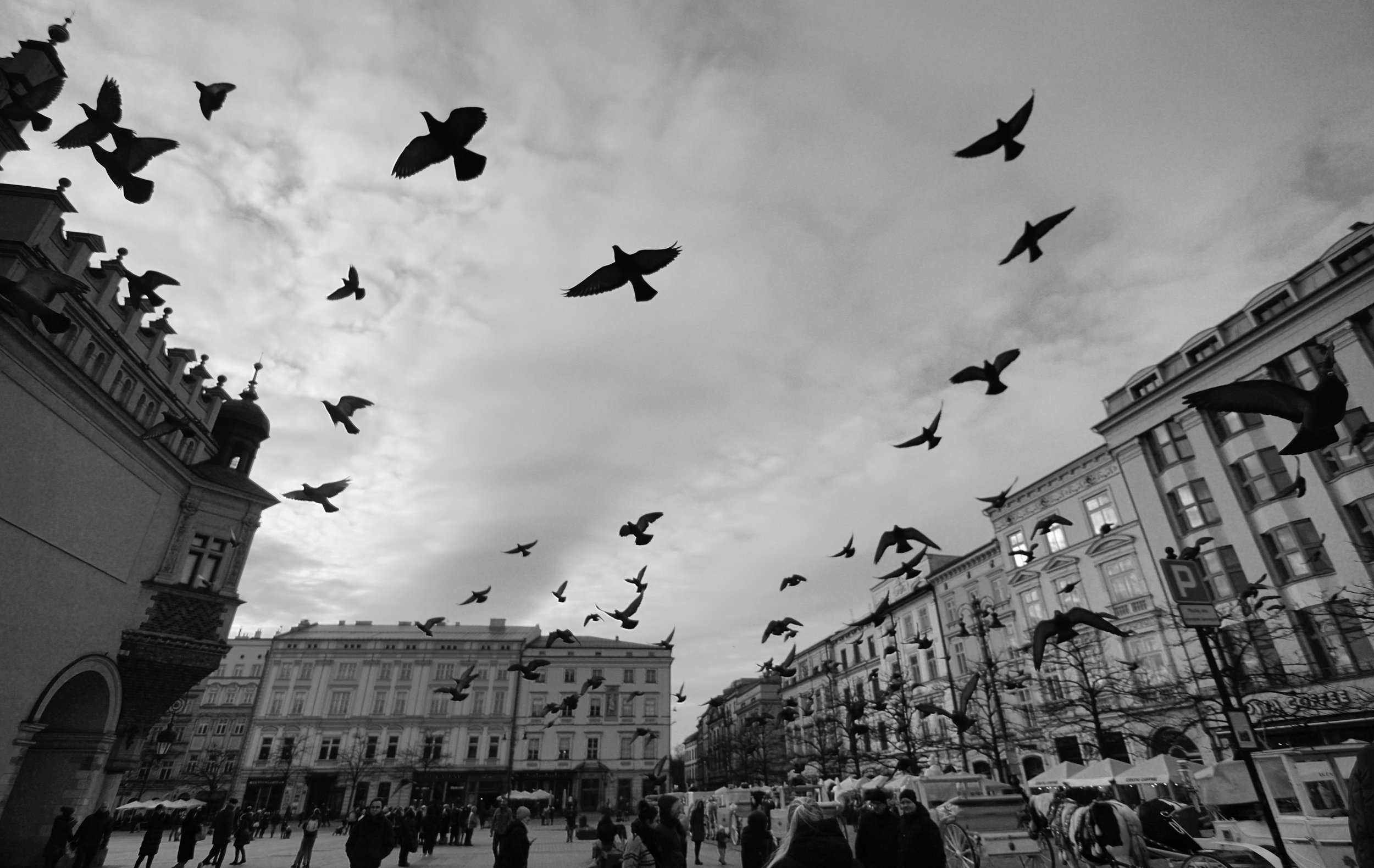
FEATHER
LINE
Huina Zheng
Grandma said if she plucked the longest feathers at the tips of my wings, they would begin to wither and fall off by the end of the month.
“Could we, um, use them for Coca-Cola chicken wings?” I asked.
Grandma shot me a look, one I knew too well, the same one she gave me on summer afternoons when she took me up the mountain to “watch birds.” We didn’t really watch birds, I guess. We went to catch the nymphs of black cicadas, which everyone called Baby. Grandma said we must keep it secret. If the villagers found out, everyone would come, and we’d go home empty-handed.
At sunset, she clicked on her flashlight and led me into the lychee grove. We had to hurry, to catch them just as they broke through the soil and started up the bark; otherwise, after four hours of ecdysis, they would fly, and then, well, we could no longer eat them. Grandma always blamed a weak flashlight when she couldn’t find any. I asked to bring another, but she told me to keep quiet. My clumsy hands would only scare them off.
“Here!” I grabbed the small brown bug. It quivered on my fingertips, its hard shell like a mouth about to open.
“The ones that just molted are the most nourishing. The shell hasn’t hardened yet,” she whispered.
“Like my wings?” I said. “So you pull out the flight feathers as soon as they grow.”
“So you won’t fly away.” She kept walking, as if that would stop my wings from sprouting again next month. “Only after you were born did I learn this hurts the least. Not like when your mother was little… we used scissors. She couldn’t bear it, flew crying all over the mountain. In the end she couldn’t keep your father.”
My father left after I was born. Grandma swore he couldn’t stand my mother’s wildness. She said my mother couldn’t stand pain. She even made a fuss over her period. Not like Grandma, who cut off her own wings with a knife, teeth clenched, no matter how it hurt. The villagers said he ran because I was a girl; he wanted a son, and I disappointed him. But my mother said she drove him off to protect me, so I wouldn’t think I was a burden. After he left, though, she flew to the market town and only came back at the Spring Festival. Maybe without me she really could fly higher, I don’t know. When I was three, my father died. Eating roast pigeon with his new wife, a wing-shaped bone lodged in his throat. Doctors worked on him for a day and a night; the bone grew there and finally carried him off. I never got the chance to ask him the truth.
Grandma’s beam skipped through the trees, but wherever it fell, her shadow walled off my view. I chewed my nails, waiting for her to find the next Baby, but after circling and circling we still had nothing.
The stars winked at me. I wondered if, maybe, our ancestor was watching from above. Grandma said my wings came from her side of the bloodline. That we were descended from a fairy who once served the Jade Queen. One morning, distracted by a butterfly, she let the cat wander into the Queen’s garden and eat her sacred golden beetle. The Queen was furious. As punishment, she sent the fairy down to earth and cursed her line to bear only daughters, each born with wings.
“We’re all imprisoned for chasing freedom,” Grandma said, shuffling home, her back hunched, the stubs of her wings like a pair of little feet pacing beneath her skin. “Don’t be like your mother.”
The night wind passed, and the roots of my wings prickled with that familiar ache. It didn’t feel like growing or shrinking, more like… a call. I followed Grandma, but my eyes kept to the trunks. My hands slid up the bark from bottom to top. She urged me to keep up; I shouted back that I was coming. Still, my feet stayed under an unusually large lychee tree. I leaned closer, arms circling the trunk the way I clutched Grandma’s arm when insect song woke me at night. My palms met something the size of my hand. I flinched, then reached again.
It was warm, like a freshly boiled egg. My fingertips touched a hard shell, smooth, fine-lined like the creases in Grandma’s palm. Following the curve downward, I felt two wings pressed tight to its sides. When the wings gave a small shiver, the withered stubs on my back trembled in answer.
I scooped it up with both hands. “Don’t be afraid,” I whispered. “I won’t hurt you, I promise.” I rocked it as if it were a baby and patted its back. A faint sucking sound rose, like a fish on Grandma’s board opening and closing its mouth. I snapped off a short twig and placed it between its lips. Grandma had said they never eat; they live by sipping the tree’s dreams, drinking the tree’s time. That way, buried underground, they still know the world above. Grandma called again, a warning in her voice. I answered loud and ran toward her.
Only in the sitting room did she see the little creature in my arms. I told her I’d found it on the tree. She frowned, took off her reading glasses, and turned away. She said she avoided seeing too much, so her heart could stay clear and her years unbroken. One sharp glimpse, she said, and her blood pressure might shoot up, her soul wander loose from her body. She had to stay alive until I grew up. I set it in the bamboo basket. The cicada nymph already inside curled into a corner like a chick beside a hen.
Grandma grabbed Baby and shook it; clods of soil and fine roots fell. “The shell’s hard already. Must deep-fry it now.”
“No!” I snatched it back. “It wants to fly.”
A string of tiny crackles rose from its chest; with each sound, the carapace against my heartbeat quivered.
“Give it here,” Grandma said, reaching out. I stepped back and held it tighter.
She sighed. “Why don’t you understand? If you don’t eat it, your wings will keep growing.”
“Mom has wings too. I can work like Mom.”
My mother delivered food in town. She’s never stuck in traffic. The shops all fought to call her because she’s faster than the e-bikes and never needed to charge.
“Kids these days watch too much TV,” Grandma said. “Poisoned by Western notions. You think being different is a gift, never know how unlucky it makes you. Last month your mother flew too fast and got caught in the power lines. Nearly electrocuted.”
When she saw I wouldn’t let go, Grandma grabbed the other Baby and went into the kitchen. By the time I put mine back in the basket and sat at the table, she had served me a bowl of sweet-potato porridge and the deep-fried nymph. There were also eggs with dried radish and a plate of stir-fried choy sum. I pouted. The same dishes, always. I wanted chips, instant noodles, luncheon meat.
“Our food should come from nature,” Grandma said. “Only then can the soul float over the Bridge of No Return and be reborn.” She said people nowadays ate too many processed foods; their bodies gathered toxins, grew heavy, and after death they lingered in the world. “But didn’t you say chasing freedom brings a curse?” I asked. “Quiet,” she said. “Children shouldn’t interrupt adults.” I was to listen to her, or end up like my mother, unlucky because she never obeyed.
That night, Grandma ignored Baby. When we climbed into bed, I set the bamboo basket on the windowsill. Baby hummed low. Grandma said only newly winged males sang, but I knew this one was female from the way she did. She switched off the lamp and turned on her side, back to me; with those stubs, she slept that way. Her breathing evened out, threaded with snores, one long, two short.
The moonlight ran like water. A voiceless call drew me to the window. Baby trembled in rhythm; a fine seam opened along her hard back. A wet head and thorax, jade and moonlight, slipped free. The wings began to spread. When she shed the amber shell, a shimmer of scales fell from her body. Stardust. Or silent tears.
She flew three circles around me like a novice dancer, then came to rest on my pillow. I stroked her wings and heard, beneath my skin, a tiny cracking. New feathers, aching and defiant, forced their way through old wounds. I bit my lip and made no sound. Beside me, Grandma turned in her sleep, maybe dreaming, maybe not. In the half-dark, the stubs of her wings quivered too, as if, in some forgotten rhythm, they were answering mine.
***
Huina Zheng holds an M.A. with Distinction in English Studies and works as a college essay coach. Her creative work has been published in Baltimore Review, Variant Literature, Midway Journal, and other literary journals. She has received multiple honors, including nominations for the Pushcart Prize, Best of the Net, Best Small Fictions, and Best Microfiction. She lives in Guangzhou, China, with her family.