Mario Senzale
Magnolia
Oaks
Maya's mother drove her to Magnolia Oaks on a Tuesday. School was closed. "Sixteen dollars an hour," her mother said. "Plus tips. You smile, you say 'yes ma'am.' You give them what they want."
The hiring manager was Diane Faulkner. A cross rested in the hollow of her throat. "You're so articulate," she told the girl. "And you present yourself so well. You'll do wonderful here."
Paperwork was signed. Employee handbook. Direct deposit forms. A document titled "Historical Interpretation Guidelines." Three pages of what not to say. The uniform: pale blue, white apron. "Authentic," Diane said. "It transports our guests to a more elegant time."
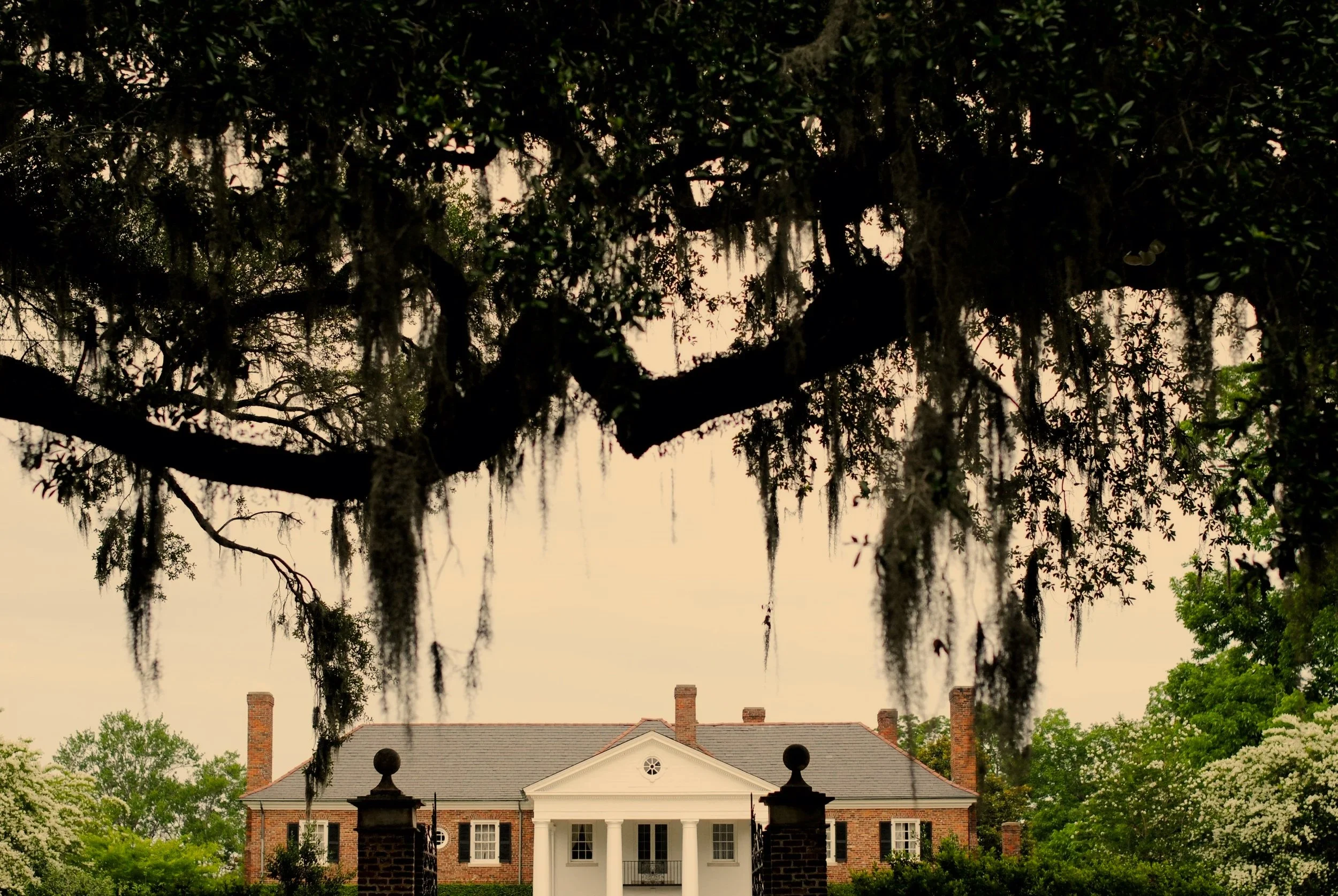
Magnolia Oaks rose on columns so white they appeared carved from light itself. The limestone had come from a quarry in Georgia, though no one remembered which one, or who had cut it, or how many hands had moved it here. The façade caught morning sun and held it without effort, the way certain faces hold their youth decades past their prime. Wisteria climbed the east portico, blooms so heavy the vines had thickened to a man's arm just to bear their weight. The scent stopped people mid-step.
Inside, heart pine floors stretched forty feet to a staircase that curved upward without visible support. Each plank sixteen inches wide. The trees they'd been cut from were already old when the house was young. The wood had darkened over decades to the color of honey left in sunlight. To walk across it was to walk across eternity. The grain ran true. Not a single knot. Not a single flaw.
A chandelier hung from the center of the foyer. Murano glass. Eighteen arms. Three hundred prisms separating light into its secret hues, staining the walls with moving veils of color that followed the sun. Six hundred pounds suspended from a single point. Beneath it stood a mahogany table polished so completely it reflected the chandelier above, and tourists standing between them found themselves suspended in an endless corridor of light, unable to determine which direction was up, unable to look away.
The first tour began at ten.
Fifteen people were led through the parlor where French wallpaper bloomed with hand-painted roses - thirty-seven per panel, repeating every six feet, each petal touched by a brush dipped in pigment mixed by hand in 1846. The fireplace was Carrara marble, veined with gray like frozen rivers. Its mantle rested on carved figures whose faces changed depending on where one stood to look at them - serene from the left, ecstatic from the right.
"The Williams family resided here for three generations," the guide said. "Known for their hospitality and their devotion to the Southern way of life."
A man in a Redskins cap raised his hand. "Did they own slaves?"
She smiled. "The Williams family employed a large household staff. Many of these workers lived on the property and were considered part of the extended family." A gesture toward the staircase. "The staircase is a cantilever design. Revolutionary for 1846."
The steps were walnut, each cut from a single plank, the grain aligned so perfectly one could trace it from bottom to top without losing the thread. No nails. No screws. No metal at all - only wood fitted to wood with such precision that one hundred seventy-seven years later not a single step made a sound. Sunlight fell through the cupola and moved across the wood throughout the day, honey-gold at morning, amber at noon, nearly red by evening, and tourists climbed through it with their phones raised, recording their ascent.
At lunch, Jennifer said a child had asked if the Spanish moss was real. Sarah said that was better than the ghost questions she got daily. Sarah looked at the new girl. "Where are you from? Your accent is lovely."
"Here."
"Your family must have stories."
"Some."
By the third week, she had learned where to stand. In the dining room: a four-second pause in front of the mahogany table, which seated twenty-four guests and had been carved from a single tree felled in 1845. In the butler's pantry: position the body so the eye traveled upward toward the crystal and away from the service stairs.
The kitchen building stood thirty yards from the main house, connected by nothing, separated by a brick path that had been laid in a herringbone pattern by someone whose name was not recorded. Inside, the hearth stretched eight feet wide. Iron hooks hung from the ceiling beam, hand-forged, their curves still perfect after nearly two centuries. The bricks themselves were extraordinary: each one made on site from clay dug from the property, fired in a kiln whose foundations could still be seen behind the carriage house. Sixty thousand bricks. Each one shaped by hand. The mortar joints were three-eighths of an inch, precise, uniform, the work of someone who understood that beauty required exactness.
Tourists photographed the hooks.
"Each brick was made on site," she said. "The craftsmanship is extraordinary."
The money paid for her mother's car. Her brother's shoes. The root canal.
"Focus on the architecture," Diane told her. "The shutters. The roof pitch. We want our guests to leave feeling elevated."
Employee of the month: certificate, gift card. "You're a natural," said Diane.
Friday brought a church group. They called her honey. They asked for cornbread recipes - forty-two dollars in tips.
At sundown, she walked to the parking lot. The asphalt was hot. Her mother's car was waiting, engine idling.
"How much?"
The lawn stretched toward the tree line. The live oaks stood where they had stood for four hundred years, their branches reaching outward, unable to rise, growing parallel to the ground under their own immense weight. Spanish moss hung in gray curtains from every branch, swaying in air too thick to be called wind. Beautiful. Slowly killing its host. The columns held the last light, that impossible white, glowing as if the stone had learned to reflect the light it once consumed. The wisteria had opened further. By morning it would be even more beautiful.
"Enough."
***
Mario Senzale is a South American writer and mathematician currently living in Indianapolis, Indiana. His stories can be found in Expat Press, Cryptic Frog, Last Girls' Club, Weird Daze and Horrific Scribes, as well as in his website, mariosenzale.neocities.org